In the competitive world of large-scale cattle farming and veterinary diagnostics, “waiting and seeing” is a costly strategy. For every day a cow remains “open” (non-pregnant) beyond the voluntary waiting period, the financial leak in feed costs and lost production grows. This guide explores how the modern bovine pregnancy test has moved from invasive manual procedures to precise, protein-based blood diagnostics, offering B2B distributors and farm managers a way to streamline reproductive cycles with clinical accuracy.
Table of Contents
- PAGs: The Biological Marker Redefining Cattle Diagnostics
- Is 26 Days the New Industry Standard for Early Detection?
- Why Switch to a Bovine Pregnancy Rapid Test Kit in Commercial Settings?
- Beyond Pregnancy: Integrating a Full Bovine Diagnostic Suite
- Frequently Asked Questions (FAQ)
- Conclusion & Next Steps
PAGs: The Biological Marker Redefining the Bovine Pregnancy Test

Traditional pregnancy diagnosis relied heavily on rectal palpation or expensive ultrasound equipment. While effective, these methods are labor-intensive and require highly specialized veterinary skills. The bovine pregnancy test industry shifted significantly with the discovery of Pregnancy-Associated Glycoproteins (PAGs).
PAGs are specific proteins produced by the binucleate cells of the embryonic placenta. Unlike progesterone, which can indicate various stages of the estrus cycle, PAGs are only found in the peripheral blood of ruminants if an embryo is present. The bovine blood pregnancy test utilizes a double-antibody sandwich lateral flow immunoassay to capture these glycoproteins. When a sample is applied, the PAGs bind with a gold-labeled conjugate, moving across a nitrocellulose membrane to form a visible purple band at the test line. This provides a binary, objective result that eliminates the “grey areas” of physical exams.
Efficiency Metrics: Blood Testing vs. Manual Methods
| Feature | Rectal Palpation | Ultrasound Imaging | SaberVet Blood PAG Test |
|---|---|---|---|
| Earliest Detection | 35 – 50 Days | 28 – 30 Days | 26 Days Post-Breeding |
| Skill Level | High (Licensed Vet) | High (Specialized Training) | Moderate (On-farm Staff) |
| Result Interpretation | Subjective | Visual/Visual Analysis | Objective (Visual Band) |
| Stress Level | High (Invasive) | Moderate | Low (Blood Draw) |
Is 26 Days the New Gold Standard? How the Bovine Pregnancy Blood Test Shortens the “Open” Window
In herd management, the most valuable information is knowing which cows are not pregnant. If you find out a cow is open at day 45, you’ve missed two potential heat cycles. But what if you knew at day 26? The bovine pregnancy blood test allows for identification nearly a full cycle earlier than traditional palpation. This “High Information Gain” enables managers to synchronize non-pregnant cows for re-breeding immediately.
According to research from the Penn State Extension, reducing the interval between breeding and pregnancy diagnosis is one of the most effective ways to improve the “Pregnancy Rate” metric. By using a bovine pregnancy blood test, farms can significantly lower their calving intervals, which directly impacts the bottom line for both dairy and beef operations.
Why Switch to a Bovine Pregnancy Rapid Test Kit in Commercial Settings? Are You Still Waiting for the Lab?
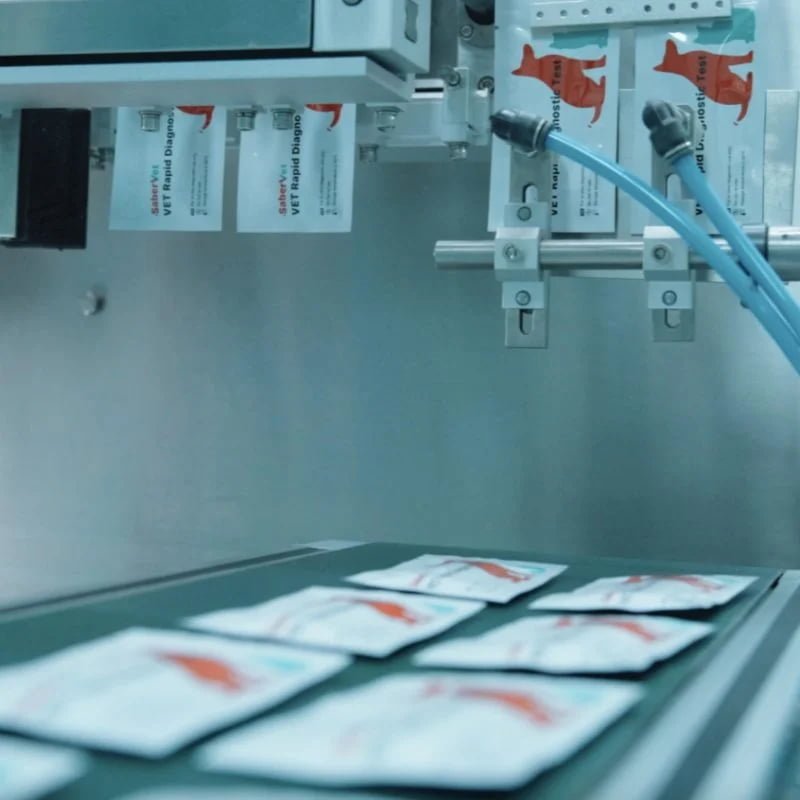
For B2B distributors and large-scale ranch managers, logistics are everything. Sending samples to a centralized laboratory often results in a 2-to-5-day turnaround time. During those days, the cow’s reproductive status remains a mystery. Why wait for a lab when a bovine pregnancy rapid test kit can provide results on-site in just 15 minutes?
The SaberVet bovine pregnancy rapid test kit is designed for field stability. It can be stored at room temperature (4-30°C) and requires no complex refrigeration, unlike many ELISA-based tests. For distributors, this means easier shipping and lower storage costs. For the end-user, it means a portable solution that can be used directly in the barn. This move toward “Point-of-Care” testing is a trend supported by the USDA Animal and Plant Health Inspection Service to ensure faster health intervention and better biosecurity.
Beyond Pregnancy: Can a Comprehensive Diagnostic Protocol Protect Your Entire Investment?
A positive bovine pregnancy test is only the beginning. Maintaining that pregnancy requires a healthy herd environment. Viral threats like BVDV can cause early embryonic death or persistent infections in calves. Therefore, smart operators combine their pregnancy screening with other critical diagnostics.
SaberVet offers a full ecosystem of tools, including the Bovine Viral Diarrhea Virus Antibody Test and the IBR Antibody Test. Integrating these tests into a single blood-draw session saves time and provides a 360-degree view of the animal’s reproductive and immune health. This holistic approach is recommended by the Michigan State University College of Agriculture to prevent infectious diseases from undermining breeding success.
Frequently Asked Questions (FAQ)
Q: How accurate is the bovine pregnancy rapid test kit compared to ELISA?
A: Most lateral flow PAG tests are designed to align closely with laboratory ELISA standards, offering high sensitivity (identifying pregnant cows) and high specificity (identifying non-pregnant cows) without the need for lab equipment.
Q: Can the test be used on whole blood?
A: Yes, our kit is compatible with whole blood (EDTA), serum, or plasma. For field use, whole blood is often the most convenient choice.
Q: How should results be interpreted if the T-line is very faint?
A: As with all immunochromatographic assays, any visible band at the Test (T) line—no matter how faint—should be interpreted as a positive result, provided the Control (C) line is also present.
Conclusion: Empowering Modern Agriculture
The transition to the bovine pregnancy test via blood markers is not just a technological upgrade; it is a management revolution. By providing accurate results as early as 26 days, the SaberVet bovine pregnancy rapid test kit empowers producers to make faster, data-driven breeding decisions.
Explore our full range of veterinary diagnostic products or visit our tutorial page to see how easy it is to implement these tools in your facility. Let’s work together to increase your herd’s productivity and health.
Reference Links & External Resources:
- USDA APHIS: Animal Health Monitoring and Surveillance
- Penn State Extension: Pregnancy Diagnosis in Cattle Guide
- MSU Agriculture: MSU College of Agriculture and Natural Resources
- NCBI/PubMed: Research on Pregnancy-Associated Glycoproteins (PAGs)
If you are looking for high-sensitivity test strips, you can find our diagnostics Sabervet® diagnostic products online store here. For those seeking integrated diagnostic systems or partnership opportunities, please explore our full ITGen® diagnostic products here.