
Intended Use
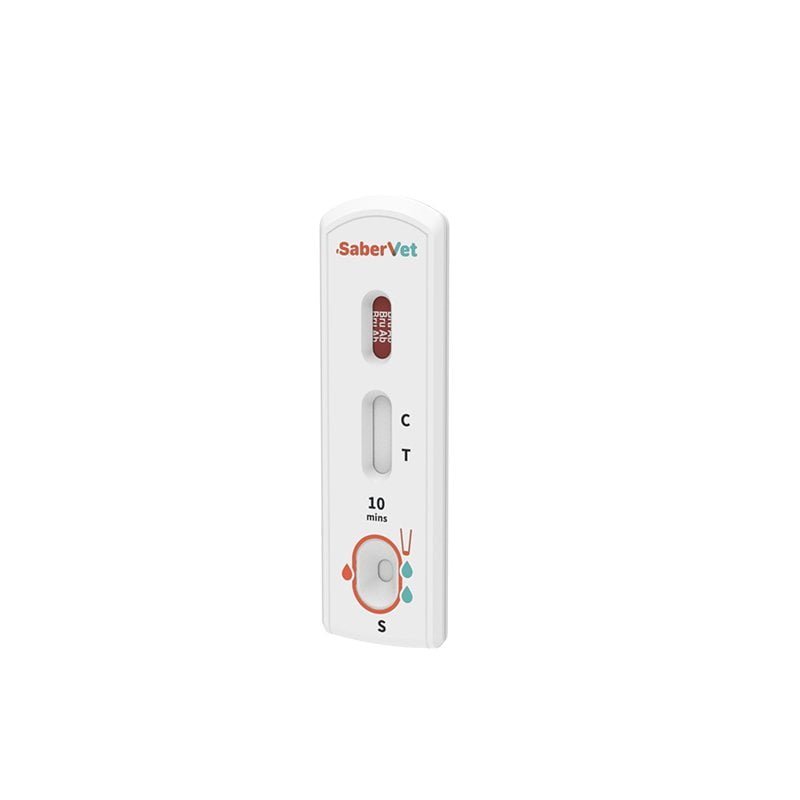
Brucella Antibody Rapid Test is a lateral flow immunoassay intended for the qualitative detection of Brucella Antibody (BRU Ab) in serum/plasma sample.
Contents
| Component | 20T/Box |
| Test device | 20 piece |
| Dropper | 20 piece |
| Buffer | 20 piece |
Specifications
| Product name | Bovine Brucella Antibody Rapid Test |
| Brand Name | Sabervet |
| Model Number | 1089191820 |
| Specimen | Whole Blood/Serum/Plasma |
| Application | Vet Health Diagnosis |
| Sensitivity | 99.80% |
| Specificity | 97.69% |
| Certificate | GMP & ISO9001 & CE |
| Assay Time | 10 Minutes |
| OEM&ODM | Available |
| Shelf Life | 3 Years |
Professional Management of Livestock Health: The Sabervet Brucella Antibody Rapid Test
Brucellosis is a highly contagious zoonotic disease that poses a severe threat to the global livestock industry and public health. Caused by bacteria of the genus Brucella, it primarily affects cattle, sheep, goats, and pigs, leading to reproductive failure, decreased milk production, and long-term infertility. Because Brucellosis can be transmitted to humans, early and accurate detection is the cornerstone of any effective bio-security program. ITGen, a leader in veterinary diagnostics, offers the Sabervet Brucella Antibody Rapid Test (BRU Ab)—a premium brucella rapid test kit designed to provide laboratory-quality results in the most demanding field conditions.
Unrivaled Diagnostic Precision
When managing a herd, accuracy is non-negotiable. The Sabervet BRU Ab test is a lateral flow immunoassay that has been rigorously validated against gold-standard methods. According to clinical performance data, this brucella test kit achieves a diagnostic sensitivity of 98.67% and a diagnostic specificity of 98.00%, with a total agreement rate of 98.33%. These metrics ensure that veterinarians and farm managers can make critical decisions regarding animal isolation and health management with absolute confidence. By choosing an ITGen solution, you are choosing a product engineered for reliability.
Simplified Workflow for Rapid Screening
Time is a critical factor in preventing the spread of infection. Traditional laboratory-based Brucellosis testing can take days to return results, during which time a single infected animal can compromise an entire herd. The Sabervet brucella rapid test kit eliminates this delay. The procedure is remarkably simple: collect a sample of whole blood, serum, or plasma, apply it to the test device using the provided capillary dropper, and add the assay buffer. In just 5 to 10 minutes, clear, easy-to-read lines appear on the cassette. This “Point-of-Care” efficiency allows for immediate action on-site.
A Cost-Effective Bio-Security Solution
For many farm owners, the brucella test kit price is an important consideration. However, the cost of an undetected outbreak far outweighs the investment in regular screening. ITGen provides competitive brucella test kit price structures that allow for large-scale, routine testing without straining the farm’s budget. By implementing a proactive testing strategy with the Sabervet brand, producers can avoid the catastrophic costs associated with government-mandated culls, trade restrictions, and human infection medical expenses.
Versatile and Field-Ready
The Sabervet brucellosis test kit is designed for the reality of veterinary work. It requires no specialized laboratory equipment or electricity. The kits are stable at room temperature(4-30 degrees Celsius), meaning they do not require a cold chain for transport or storage—a significant advantage for remote agricultural regions. Each kit is a closed system that includes the test device, buffer, and capillary droppers, ensuring that everything needed for a successful test is contained in one package.
The ITGen Commitment to Excellence
At ITGen, our mission is to safeguard animal welfare through innovative diagnostic technology. The Sabervet line of products represents the pinnacle of field-based IVD (In-Vitro Diagnostics). This brucellosis test kit is more than just a diagnostic tool; it is a shield for your livestock investment. Whether you are conducting routine surveillance or responding to a suspected outbreak, our technology provides the clarity needed to maintain a Brucella-free environment. With a clear interpretation system—where a C-line ensures validity and a T-line indicates the presence of antibodies—we take the complexity out of disease management.
Trust ITGen and the Sabervet series to provide the accuracy, speed, and value your farm deserves. Invest in a professional brucella test kit today to secure the future of your herd.
Pathological Introduction
Canine brucellosis is a zoonotic disease caused by Brucella in both humans and animals. It mainly causes canine brucellosis and reproductive disorders in dogs, and can also lead to intervertebral discitis, osteomyelitis, meningoencephalitis, and uveitis.
Adult dogs infected with Brucella rarely show severe clinical symptoms, or may only exhibit lymphadenitis. They may also show systemic symptoms after a latent period of 2 weeks to as long as 6 months. Pregnant bitches often miscarry between 40 to 60 days of pregnancy. Within the 1 to 6 weeks before miscarriage, infected dogs generally do not have high body temperature, but the vulva and vaginal mucosa are swollen, and there may be light brown or greyish-green discharge from the vagina.
Miscarried fetuses often exhibit partial tissue autolysis, subcutaneous edema, congestion, and subcutaneous hemorrhage in the abdominal region. In early pregnancy (10 to 20 days after mating), embryos may die and be absorbed by the mother’s body. Miscarried bitches may develop uteritis and subsequent infertility after repeated mating. Male dogs may develop orchitis, epididymitis, scrotal swelling, scrotal dermatitis, and sperm abnormalities. In addition to reproductive system symptoms, infected dogs may also develop arthritis, tenosynovitis, and occasionally limping. Some infected dogs may also develop uveitis.
Detection Methods
When pregnant bitches have miscarriages, bitches are infertile, or male dogs have orchitis or epididymitis, this disease should be suspected. A comprehensive diagnosis can be made on the basis of epidemiology, clinical symptoms, bacteriological examinations, and serological reactions.
When there are large numbers of miscarriages in pregnant bitches, and repeated infertility in bitches, or when male dogs get orchitis, epididymitis, scrotal swelling, and reduced breeding ability in a dog population, this disease should be suspected. Sometimes, a large number of swollen abnormal cells can be seen in semen smears of those male dogs.
After dogs are infected with Brucella, bacteremia can persist for months to years. Therefore, taking blood for bacterial culture is the best method for diagnosis. Aseptically collected blood samples are inoculated into nutrient broth and cultured under aerobic conditions for 3 to 5 days. Then these samples are subcultured onto solid culture media for identification.
Brucella in dogs grows relatively slowly, taking 48 to 96 hours to form visible colonies. Alternatively, samples can be taken from aborted fetal membranes, fetal stomach contents, or diseased liver, spleen, and lymph node tissues. They are made into smears, stained (using Macchiavello or modified Ziehl-Neelsen methods) and examined under a microscope. Red-colored bacteria can be seen under the microscope. In this way, the disease is diagnosed.
Conventional testing methods require specific laboratory environments and trained personnel. But the ITGEN Canine Brucella Antibody Rapid Test Strip is easy to use, unaffected by environmental factors or personnel, and is suitable for initial screening of antibodies against canine brucellosis.
Treatment/Prevention Plan
The following comprehensive measures should be taken for prevention:
Take regular serological tests for canine populations (especially breeding populations), with blood culture if necessary. It is best to perform these tests twice a year, and any positive dogs should be strictly isolated. Only negative dogs are kept for breeding purposes.
Encourage in-house breeding as much as possible. Newly acquired dogs should be isolated and observed for one month, and only after quarantine and confirmation of good health should they be introduced into the population.
Male breeding dogs should undergo quarantine and confirmation of good health before participating in breeding.
Dog kennels and exercise areas should be regularly disinfected. The areas, pens or other equipment contaminated by miscarriage materials should be thoroughly disinfected.
Economically non-valuable diseased dogs can be euthanized. Diseased dogs with value can be isolated and treated, but strict veterinary hygiene measures must be implemented.