Waiting weeks for a vet visit costs you money every single day. Non-pregnant cows eat feed, take up space, and delay your next breeding cycle.
You can check if a cow is pregnant without a vet by testing for Pregnancy-Associated Glycoproteins (PAGs) in a blood sample. PAGs are proteins released by the embryo after conception. A rapid test strip can detect them in 15 minutes, with results readable as early as Day 26 post-breeding.
I have spoken with farm managers across Southeast Asia and Europe who used to wait 6 to 8 weeks before confirming pregnancy in their herds. That wait is now unnecessary. In this post, I will walk you through exactly how on-farm PAG testing works, why it matters for your operation, and how to read your results correctly.
1. Why Wait for a Vet?
Every day a non-pregnant cow goes undetected is a day of lost production. The scheduling delays alone can push your calving interval past 400 days — and that number destroys your margins.
Traditional pregnancy diagnosis relies on rectal palpation or ultrasound. Both methods require a trained vet on-site, which means booking appointments, paying call-out fees, and working around someone else’s schedule. For large herds, this is a serious operational bottleneck.
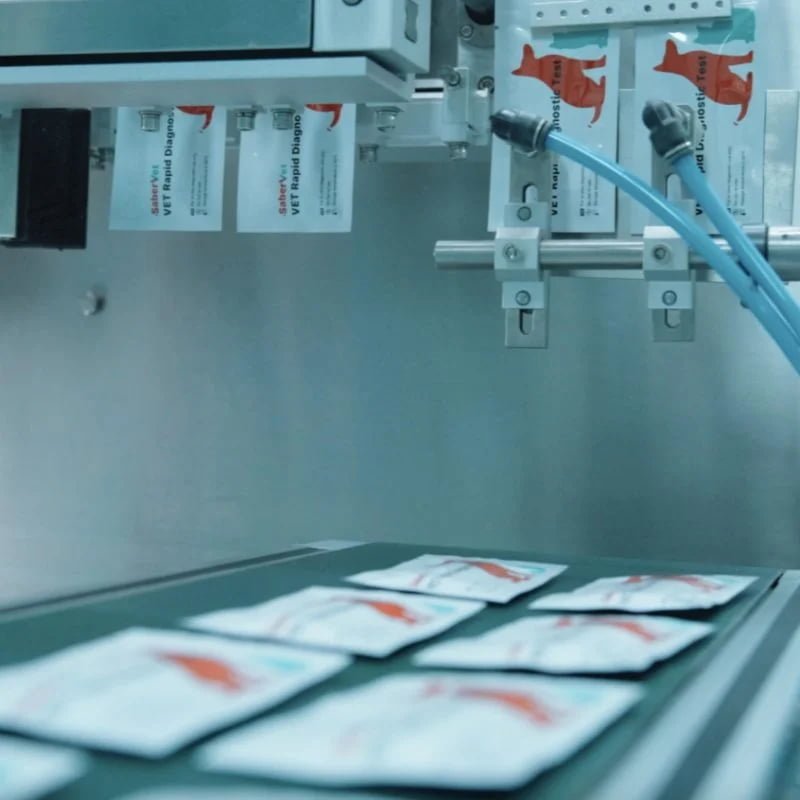
PAG-based rapid testing removes the vet from the equation for routine pregnancy checks. The test uses a blood sample and a pre-loaded test strip. No equipment, no professional license, and no waiting room. Farm staff can run the test directly in the barn.
I remember a farm operator in Indonesia telling me he used to lose an average of 45 days per open cow before he even knew she had not conceived. That gap was invisible to him because he had no way to test early. Once he moved to on-farm PAG testing, his team was identifying open cows within 30 days of breeding and re-submitting them immediately.
The core problem with waiting for a vet is not just cost. It is the hidden cost of inaction. Every undetected open cow delays your next calf, disrupts your feeding schedule, and skews your production forecast.
What Makes PAGs a Reliable Marker?
PAGs — Pregnancy-Associated Glycoproteins — are proteins produced specifically by the cells of the developing placenta (binucleate cells of the embryo). They are not present in non-pregnant animals at detectable levels. This specificity makes them one of the most reliable biological signals available for early pregnancy detection in cattle.
| Diagnostic Method | Earliest Detection | Requires Vet? | Cost Per Test | Time to Result |
|---|---|---|---|---|
| Rectal Palpation | Day 35–45 | Yes | High | Same day |
| Ultrasound | Day 25–28 | Yes | High | Same day |
| PAG Rapid Test | Day 26 | No | Low | 15 minutes |
| Lab ELISA (PAG) | Day 26 | No (send sample) | Medium | 1–3 days |
The rapid test format I am describing here uses a double-antibody sandwich system. One antibody captures the PAG molecule from the blood sample. A second antibody then binds to it and produces a visible line on the strip. The entire reaction happens in 15 minutes at room temperature.
This is not a new technology borrowed from human diagnostics. It was developed specifically for bovine PAG detection, which means the antibodies are calibrated to the proteins that cattle embryos actually produce. The result is a test with high specificity and minimal cross-reactivity with other bovine proteins.
2. Missed the Breeding Window?
Missing a breeding cycle in cattle is not a minor inconvenience. A single missed estrus adds 21 days to your calving interval. Two missed cycles add 42. The financial impact compounds fast.
The traditional model gives you very little warning. You breed a cow, wait 6 weeks, call the vet, and only then find out she did not conceive. By that point, you have already missed two or three estrus cycles you could have acted on.
PAG testing allows you to confirm a successful pregnancy as early as Day 26 post-breeding. This means you can identify non-pregnant cows before the next estrus cycle begins, re-submit them immediately, and keep your herd moving forward without losing weeks of production time.
The economic logic here is straightforward. A shorter calving interval means more calves per cow per year. More calves per cow per year means a higher return on your feed and management investment. Early detection is not just a convenience — it is a direct revenue driver.
How Early Detection Changes Your Breeding Calendar
When I walk through the numbers with farm managers, the shift becomes very clear. Here is a simple comparison of two scenarios:
| Scenario | Detection Day | Re-breeding Delay | Calving Interval Impact |
|---|---|---|---|
| Vet palpation at Day 45 | Day 45 | 45+ days post-breeding | +45 days if open |
| PAG test at Day 26 | Day 26 | 26 days post-breeding | +26 days if open |
| PAG test at Day 26 (catches next estrus) | Day 26 | Next estrus at Day 42 | Minimal impact |
In the best case, a farm using Day 26 PAG testing can catch an open cow, wait for her next natural estrus at approximately Day 42, and re-breed her — all before a vet-confirmed diagnosis would even have been scheduled.
For commercial farms running 200 or more cows, this difference across the herd adds up to dozens of extra calves per year. That is not a marginal gain. It is a structural improvement in herd productivity that compounds every season.
The other benefit is psychological. Farm managers who test early stop guessing. They make decisions based on data, not on assumptions about which cows “look” pregnant. This shift from guesswork to measurement is the core of what precision livestock farming is about.
3. No Lab Required?
The word “diagnostic” often implies a lab, a centrifuge, a technician in a white coat. For most of the history of veterinary diagnostics, that assumption was correct. PAG rapid testing breaks it.
The test is designed to be run in the field. There is no cold chain requirement for the test itself during use, no specialized equipment, and no training beyond a basic instruction sheet. If your staff can draw blood from a jugular vein, they can run this test.
You collect a small blood sample from the cow’s jugular or tail vein, allow it to separate into serum, apply the serum to the test strip, and read the result at 15 minutes. The entire process requires only a blood collection tube, a centrifuge or gravity separation, and the test cassette.
I have seen this process run smoothly on farms with no laboratory infrastructure at all. A small benchtop centrifuge, a rack of collection tubes, and a box of test cassettes — that is the entire setup. Some farms skip the centrifuge entirely and allow the blood to settle by gravity in a refrigerator overnight, then pipette the clear serum layer the next morning.
What You Need to Run the Test On-Farm
Let me break down the full process into its components so you can assess what your farm already has and what you might need to add.
| Step | What You Need | Notes |
|---|---|---|
| Blood collection | Vacutainer tube, needle, holder | Whole blood, serum, or plasma |
| Serum separation | Centrifuge OR gravity separation | Can be settled in fridge overnight |
| Sample application | Pipette or dropper | 1 drop specimen + 3 drops buffer |
| Test reading | Test cassette, timer | Read at exactly 15 minutes |
| Record keeping | Management software or log | Record IDs and results |
The cassette itself is a self-contained unit. The antibodies, the conjugate pad, the nitrocellulose membrane — all of it is pre-loaded at the factory. You do not mix reagents. You do not calibrate equipment. You apply the sample and wait.
This simplicity is not a compromise on accuracy. The double-antibody sandwich format used in these cassettes is the same principle behind many clinical-grade diagnostics. The difference is that the format has been adapted for field use, with a visual readout that requires no reader device. A colored line is positive. No line is negative. That is the entire interpretation logic.
For distributors and agents supplying farms that have never run in-house diagnostics before, this low barrier to entry is a major selling point. The learning curve is measured in minutes, not days.
4. Are Your Results Accurate?
A test is only useful if you trust the result. This is the question I hear most often from farm managers who are new to rapid diagnostics. And it is the right question to ask.
Rapid tests have a reputation problem in some markets — not because the technology is unreliable, but because poor-quality products have created doubt. When you are using a well-manufactured PAG test with validated sensitivity and specificity, the accuracy is high enough for routine herd management decisions.
To get accurate results, you must read the test at exactly 15 minutes, use clear serum (not hemolyzed or lipemic samples), and store the cassettes within the recommended temperature range. A single pink or red line in the control zone only means negative. Two lines — regardless of the second line’s intensity — means positive.
The most common source of error I see is not the test itself. It is the sample. Hemolyzed blood — blood that has been shaken, stored improperly, or drawn with trauma — can interfere with the antibody reaction and produce a faint or absent control line. When the control line does not appear, the test is invalid and must be repeated with a fresh sample.
Common Mistakes and How to Avoid Them
Understanding where errors happen is the fastest way to build confidence in your results. Here is a structured breakdown of the most frequent problems and their solutions:
| Error Type | Cause | How to Avoid |
|---|---|---|
| Invalid result (no C line) | Hemolyzed sample, insufficient volume, expired cassette | Check expiry, use correct volume |
| False negative | Testing too early (before Day 26) | Wait until Day 26 post-breeding |
| False positive | Extremely rare with PAG tests | Use clinical findings for confirmation |
| Faint positive line misread as negative | Operator error | Any line in T region is positive |
| Result read too late | Forgetting to set a timer | Invalid after 20 minutes |
I want to address the question of sensitivity directly. PAG levels in early pregnancy are lower than in mid or late pregnancy. A Day 26 test result will show a lighter positive line than a Day 60 test result. This does not mean the test is failing. It means the biological signal is weaker at that stage. The line is still there. The result is still positive.
For farms that want to build a verification protocol, I recommend a simple two-step approach: test at Day 26–28 for initial screening, then retest positive cows at Day 45–50 to confirm ongoing pregnancy. This two-point system catches early embryonic loss — a real phenomenon in cattle — and gives you a more complete picture of your conception and retention rates. It also gives your team practice with the test format, which builds confidence in the results over time.
Conclusion
You do not need a vet to confirm pregnancy in your herd. A PAG rapid test gives you accurate results at Day 26, using only a blood sample and 15 minutes. Start testing earlier, re-breed faster, and stop losing money on open cows.