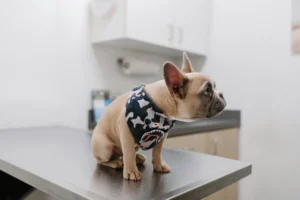
I use a colloidal gold test strip when I want quick and correct results. The SaberVet Salmonella Antigen Rapid Test shows how new colloidal gold test strip technology works. Colloidal gold particles stick to targets and make lines you can see. The table below shows how fast and correct the tests are:
| Metric | Colloidal Gold Test Strip | RT-PCR |
|---|---|---|
| Sensitivity | 71.8% | Higher |
| Specificity | 100% | Lower |
| Turnaround Time | 20 minutes | Longer |
A colloidal gold test strip gives results fast. I think it is simple to use. Many clinics and animal test makers use colloidal gold test strip solutions for quick detection.
How Does a Colloidal Gold Test Strip Work?

I use colloidal gold test strips when I need results fast. The SaberVet Salmonella Antigen Rapid Test is a good example of this kind of test. This tool uses colloidal gold immunochromatography technology to give results in 5 to 10 minutes. I trust this test because it is sensitive and specific. The test helps me find Salmonella antigens quickly and correctly. I see clear lines that make the results easy to read.
What Is Colloidal Gold Immunochromatography?
Colloidal gold immunochromatography is a way to find antigens or antibodies fast. I use this technology for quick tests. Here is how it works:
- The liquid sample moves through a strip by capillary action.
- Some molecules on the strip interact with the analyte.
- Colloidal gold acts as a label because its color is easy to see.
- The sample goes through different zones, including a conjugate release pad with special antibodies.
- The detection zone has parts that react with the antibody-antigen complex.
I use colloidal gold lateral flow test strips for covid-19 antigen detection, antigen and antibody screening, and other tests. The main parts of a colloidal gold test strip make the process work well and give good results.
| Component | Function |
|---|---|
| Sample pad | Holds the test sample, filters, and buffers to reduce interference. |
| Gold pad | Contains colloidal gold-labeled antibodies that track the reaction between antibodies and antigens. |
| Nitrocellulose membrane | Has detection and quality control lines, helps aggregate colloidal gold for result interpretation. |
| Absorbent pad | Allows liquid sample flow, drives gold-labeled antibody to react with antigen on the detection line. |
I see how immunochromatography technology makes fast testing possible. The bright color of colloidal gold helps me read results without special tools.
How Is a Sample Collected and Applied?
I follow four steps with the SaberVet Salmonella Antigen Rapid Test:
- Sampling: I use a clean swab to collect the sample.
- Dilution: I mix the sample with the buffer.
- Loading: I put the mixture on the sample pad.
- Interpretation: I wait 5 to 10 minutes and check the results.
I think this process is easy and quick. The test kit has everything I need. I use samples like canine whole blood, serum, or plasma. The sample pad filters and prepares the sample so the test is correct. I see how animal diagnostic reagent makers design these tests for easy use in clinics and labs.
| Sample Type |
|---|
| Canine whole blood (anticoagulated) |
| Serum |
| Plasma |
I like how colloidal gold lateral flow test strips make screening and testing fast. The steps for collecting and using the sample are simple and clear.
How Do Colloidal Gold Conjugates Bind Targets?
Colloidal gold conjugates are important for detection. I see how special antibodies stick to gold nanoparticles. These antibodies attach to the target antigen in the sample. The binding process depends on a few things:
- Not all antibodies stick to the target antigen after they are put on gold nanoparticles.
- Steric restrictions can make binding harder, especially with big antigen molecules.
- For small antigens, antibodies may not bind as well.
- Physical adsorption of antibodies to gold nanoparticles gives a higher binding rate, but only some antibodies stay in the right position.
- The Fab regions can make it harder for antigens to be recognized.
- If there are too many antibodies on the metal surface, antigens cannot reach them easily.
The size of colloidal gold particles also matters for binding and sensitivity:
- Smaller particles (15-20 nm) have more surface area, so more antibodies can stick.
- More binding sites help catch target analytes even at low levels.
- Bigger particles show stronger color, which can make the test more sensitive.
- Very large particles may not work as well because they do not bind as easily and move slowly.
I see how colloidal gold lateral flow test strips use these ideas for fast detection. The antibody-antigen reaction is the main part of immunochromatography technology.
How Does the Mixture Move on the Strip?
After I put the sample on the strip, the mixture moves by capillary action. How well it moves depends on a few things. The size and stability of colloidal gold particles are important. Smaller particles need less antibody to keep them from sticking together. The pH of the solution matters; I use a pH of 7.6 for the best results. The amount of antibodies and how gold nanoparticles and proteins interact affect how well the test works.
Manufacturers like animal diagnostic reagent factories make sure each batch is the same by controlling mixing rates, concentrations, size, color, hydrodynamic diameter, zeta potential, and pH. These quality checks help me trust colloidal gold lateral flow test strips.
I use colloidal gold immunochromatography for fast tests. The mixture moves along the strip so the detection zone can catch the antibody-antigen complex. I see clear lines that show if the result is positive or negative. This fast testing method helps me with screening and detection in clinics, labs, and food safety.
How Are Results Interpreted in Colloidal Gold Lateral Flow Test Strips?
What Do Test and Control Lines Indicate?
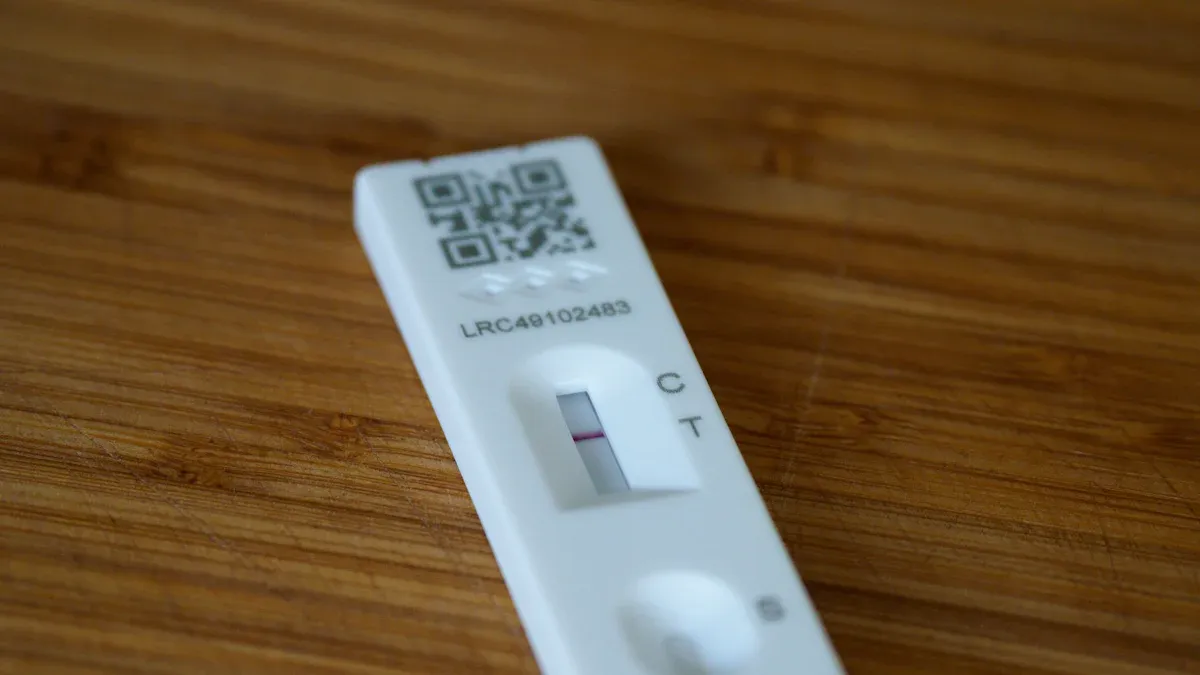
When I use colloidal gold lateral flow test strips, I look for two lines. The test line shows if the antigen is there. The control line tells me the test works and the sample moves right. I see dark red lines on the SaberVet test. These lines are easy to see, even in bright or dim rooms. This makes it simple for anyone to read the results.
| Line Type | Purpose |
|---|---|
| Test Line | Indicates the presence of the target analyte. |
| Control Line | Confirms that the assay is functioning correctly and that the sample is flowing properly. |
I trust the SaberVet test because it is sensitive and specific. The gold nanoparticle technology gives clear results. I use these strips for fast testing in clinics and labs.
How to Read Positive, Negative, or Invalid Results?
I follow easy steps to read the results:
- If both the test line and control line show up, the antigen is there. This means the result is positive.
- If only the control line shows up, the result is negative. The antigen is not found.
- If no lines show up, or only the test line shows, the result is invalid.
I always use a new strip and try again if the result is invalid. If it happens again, I ask the animal diagnostic reagent company for help. This keeps my test results correct.
I use the SaberVet test for quick checks and screening. The test is sensitive and specific, so I trust what I see. The test was checked against PCR, so I know it is accurate for clinics.
What Factors Affect Diagnostics Accuracy?
I watch for things that can change how well the test works. These things can make the test wrong, like giving a false positive or false negative.
| Factor Type | Description |
|---|---|
| Hydrophobic Substances | Non-polar amino acids can cause cross-reactivity, leading to false positives due to non-specific binding with antibodies. |
| Acid Substance | Low pH can cause negatively charged colloidal gold to bind non-specifically to positively charged proteins, resulting in false positives. |
| Excessive Exfoliated Cells | High numbers of exfoliated cells can block the membrane, interfering with the flow of the sample and leading to inaccurate results. |
| Too Viscous Samples | Viscosity can slow down sample flow, causing insufficient movement of gold-labeled antibodies and leading to false positives. |
| Reagent Problem | Deterioration of reagents due to prolonged exposure can result in false positives. |
| Problems of Capture Antibodies | Unstable capture antibodies can lose specificity, leading to false negatives. |
| Sample Problem | An imbalance in antigen-antibody ratios can cause weak positive or false-negative results, especially in high antigen concentrations. |
| Sensitivity of Reagents | Limited sensitivity of reagents can lead to false negatives, particularly during low antigen content periods. |
| Reagent Preservation Problems | Moisture exposure can weaken detection strips, leading to decreased sensitivity and accuracy. |
| Immune Escape | Variants of SARS-CoV-2 can reduce detection rates, contributing to false negatives. |
I keep my test strips in a cool, dry place. I do not let them get hot or wet because that can hurt the reagents and make the test less sensitive. I always follow the instructions from the animal diagnostic reagent factory. This helps me get good and correct results.
I use colloidal gold lateral flow test strips for fast testing in clinics and labs. I trust the SaberVet test because it is sensitive and specific. The clear lines and easy steps make it a great tool for clinical work.
I use colloidal gold test strips because they work fast. The steps are easy to follow. Gold nanoparticles connect with an antibody first. Then, the sample moves along the strip. The test line shows a signal if the antibody finds the target. I trust the SaberVet Salmonella Antigen Rapid Test. It gives results in just a few minutes. This helps clinics and factories keep people and animals safe. Food safety teams also use these tests to protect health.
FAQ
How do colloidal gold test strips help me in rapid diagnostics?
I use colloidal gold test strips to get fast results. The strips show clear lines. I trust them for quick screening in clinics and labs.
Where can I get reliable colloidal gold test strips?
I order from an animal diagnostic reagent factory. They supply high-quality strips. I check their products for accuracy and batch consistency.
What makes colloidal gold test strips easy to use?
I follow simple steps: collect, dilute, load, and read. The strips need no special tools. I see results in minutes.
If you are looking for high-sensitivity test strips, you can find our diagnostics Sabervet® diagnostic products online store here. For those seeking integrated diagnostic systems or partnership opportunities, please explore our full ITGen® diagnostic products here.