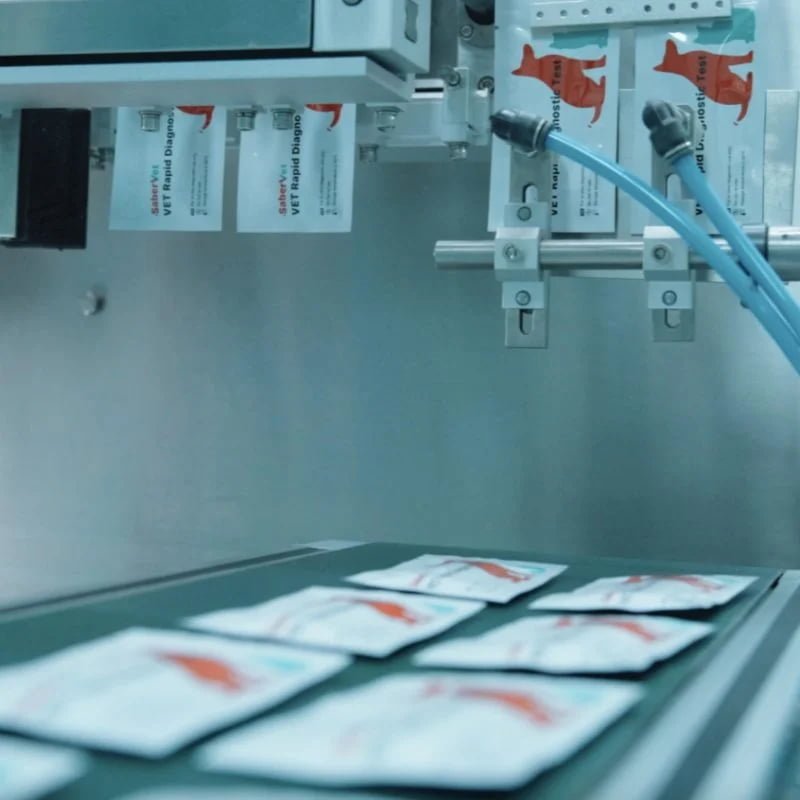
Are you confused by a positive FIP antigen test1 in a healthy-looking cat? This doubt can make you question the test's reliability and cause unnecessary worry for pet owners.
A positive Feline Infectious Peritonitis (FIP) antigen test often indicates the presence of the common Feline Coronavirus2 (FCoV3), not necessarily the fatal FIP disease4. The test detects a protein shared by both the harmless virus and its mutated form, making it a marker for exposure, not a definitive diagnosis.
I’ve spent years working with vets and distributors on this exact issue. We all want a simple yes-or-no answer for FIP, but the biology of the virus is complex. A positive result often starts a panic, when it should really start a conversation. The test is giving you a piece of the puzzle, not the whole picture. Understanding what that piece means is the key to using these tests effectively. Let's break down what's really happening when you see that second line appear.
What does an FIP antigen test actually detect?
Have you ever wondered what the test is truly looking for in a sample? This uncertainty can lead to misinterpreting results and making flawed clinical judgments about a cat's health.
An FIP antigen rapid test detects the Feline Coronavirus (FCoV) nucleocapsid (N) protein. This protein is nearly identical in both the common, mild enteric FCoV and the rare, mutated Feline Infectious Peritonitis Virus (FIPV). The test cannot distinguish between the two forms of the virus.
When we designed our antigen tests, we targeted the most stable and abundant viral component: the N protein. This makes the test very sensitive for detecting an active FCoV infection. The problem is, FCoV is extremely common. Most cats are exposed to it at some point, and it usually just causes mild diarrhea or no symptoms at all. FIP only develops when this common virus mutates inside a specific cat's body, which is a rare event. Because our test detects the protein found in both the harmless and the mutated virus, a positive result simply confirms the cat is shedding Feline Coronavirus. It does not, by itself, confirm a diagnosis of FIP. I once worked with a large cattery that had nearly all its cats test positive. The owner was terrified of an FIP outbreak. But after we talked, they understood it was just evidence of widespread, harmless FCoV in a multi-cat environment. None of the cats were sick.
| Feature | Feline Enteric Coronavirus (FCoV) | Feline Infectious Peritonitis Virus (FIPV) |
|---|---|---|
| Prevalence | Very common, especially in multi-cat homes | Very rare |
| Symptoms | Often asymptomatic, or mild diarrhea | Always severe and fatal if untreated |
| Mutation | The original, widespread form | A mutated form of FCoV |
| Test Detection | Detected by antigen tests (N protein) | Detected by antigen tests (N protein) |
How do sample quality and environment affect FIP test results?
Are you seeing inconsistent results even when using the same test kits? Factors beyond the test cassette itself can influence the outcome, leading to confusion and a lack of confidence.
A positive result can be influenced by high viral shedding in multi-cat environments, interference from the sample matrix like feces, or simple operator error in reading a faint test line. These factors contribute to results that are technically correct but diagnostically misleading without proper context.
The test's result is only as good as the context it's used in. I've seen perfectly functional tests get blamed for "false positives" when the issue was environmental or procedural. For example, in a shelter or breeding facility, FCoV can be everywhere. Healthy cats shed the virus in their feces, so you will get many positive antigen tests. This is not a test failure; it is an accurate reflection of a high-prevalence environment. The test is correctly identifying cats that are shedding the virus. It's the interpretation that can go wrong. We must also consider the sample itself and how the test is performed. A simple mistake can change everything.
High Viral Shedding Environments
In a single-cat household, a cat may never encounter FCoV. But in a multi-cat setting, the virus spreads easily through shared litter boxes. A high percentage of these cats will be actively shedding the common, harmless FCoV at any given time. Testing them will accurately produce a positive result, which simply confirms the presence of this common virus.
Sample Matrix and Operator Factors
The physical sample can also cause issues. Feces is a complex substance. Sometimes, other materials in the sample can cause a faint or ambiguous line on the test strip, a phenomenon known as matrix interference. Also, human error is a real factor. Reading the test too early or too late can lead to an incorrect conclusion. A very faint line, sometimes called a "ghost line," might be misinterpreted as a definitive positive, causing undue alarm. It's critical to follow the instructions for timing and interpretation that we provide with every kit.
Is an FIP antigen test a diagnostic or a screening tool?
Do you use a positive FIP antigen test as the final word for a diagnosis? Relying on this single piece of data as definitive proof can lead to serious misjudgments in patient care.
The FIP antigen test is a screening tool, not a standalone diagnostic tool. Its purpose is to detect the presence of Feline Coronavirus. A positive result should prompt further investigation, while a negative result helps to rule out FCoV shedding, but neither confirms or denies FIP disease on its own.
This is the most important concept I try to communicate to my partners. We manufacture a screening tool. Its job is to quickly and affordably identify cats that have the target virus. It is the veterinarian's job to use that information as part of a larger diagnostic picture. A positive test on a sick cat that shows classic FIP symptoms (like fever, weight loss, and abdominal fluid) is a strong piece of supporting evidence. But a positive test on a completely healthy cat is just an interesting finding. It means the cat has FCoV, and that's it. It requires monitoring, but not immediate alarm. Conversely, a negative result is also very useful. It makes an active FIP diagnosis much less likely, as FIP cats typically shed large amounts of the virus.
| Aspect | Use as a Screening Tool (Correct) | Use as a Diagnostic Tool (Incorrect) |
|---|---|---|
| Purpose | To identify FCoV presence in a population or individual. | To definitively confirm FIP disease. |
| Patient | Can be used on healthy or sick cats. | Assumes a positive result equals FIP disease. |
| Positive Result | Indicates FCoV is present. Requires further clinical evaluation. | Mistakenly interpreted as a final FIP diagnosis. |
| Negative Result | Strongly suggests the cat is not shedding FCoV. | Mistakenly interpreted as ruling out FIP completely. |
| Our Role | As a manufacturer, we provide a reliable tool for FCoV detection. | This misapplication is outside the test's intended use. |
Conclusion
Most "false positive" FIP antigen results are not test failures. They are correct detections of the common Feline Coronavirus, which must be interpreted with clinical signs for an accurate diagnosis.
Understanding the implications of a positive FIP antigen test can help pet owners make informed decisions about their cat's health. ↩
Exploring the relationship between Feline Coronavirus and FIP can clarify misconceptions and reduce unnecessary panic. ↩
Learning about FCoV can help cat owners understand common viral infections and their implications. ↩
Gaining insight into FIP disease can help in recognizing its signs and seeking timely veterinary care. ↩